
The Core Function of the Series Reactor is to Reshape the Impedance Logic of the Branch
In the microscopic structure of industrial power distribution systems, the Series Reactor is never an isolated entity; it is always part of the same logical branch as the Power Factor Correction capacitor banks. Its fundamental difference lies in its "series" topology: it is placed at the front end of the capacitor, acting as a physical barrier between the grid and the capacitor. The core purpose of this design is not to compensate for reactive power, but to reshape the impedance characteristics of that specific branch.
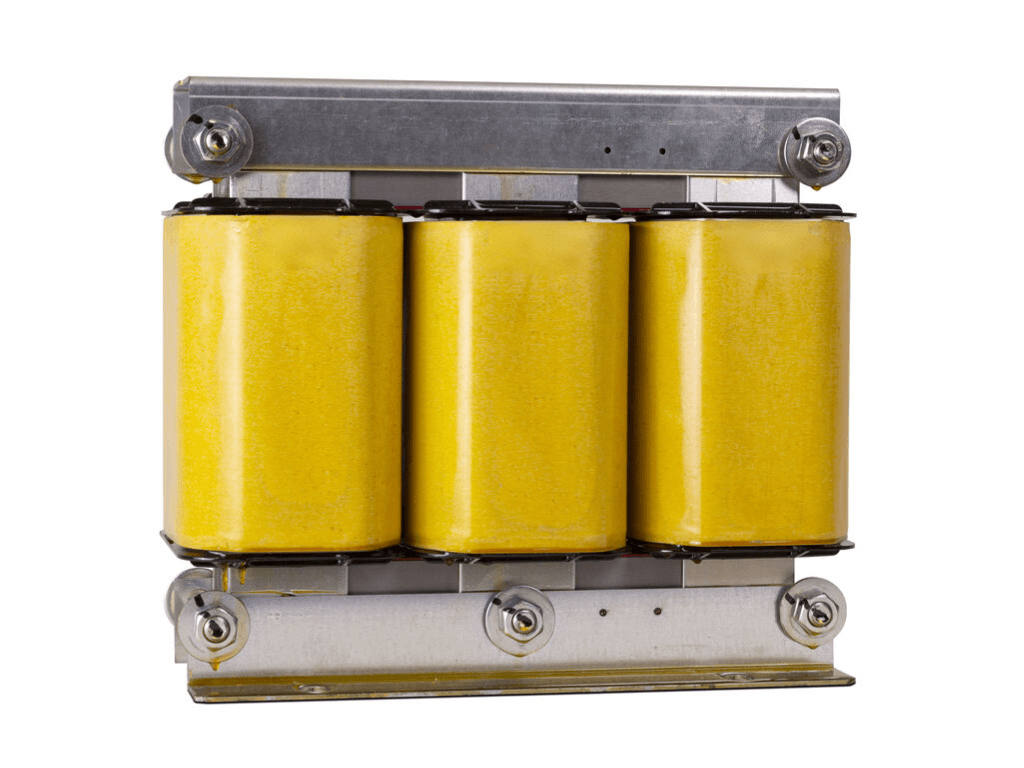
When the grid contains a large volume of harmonic currents generated by variable frequency drives and rectifiers, the reactance value of a capacitor decreases significantly as the frequency rises. Without the isolation provided by a Series Reactor, the capacitor bank is highly susceptible to Parallel Resonance with the grid impedance, leading to current amplification by several magnitudes. By introducing a Series Reactor, we artificially shift the resonance point of the branch. In the HertzKron technical framework, we precisely calculate the Reactor Rate (such as 7% or 14%) to ensure that while reconstructing electrical order, the system effectively suppresses inrush current and blocks high-order harmonics from eroding the capacitor dielectric.
The Shunt Reactor Acts to Suppress Voltage Drift on Long-Distance Lines
Entirely different from the series structure serving the load end, the Shunt Reactor is a purely inductive load connected in parallel to the system busbars. Its physical essence is an "Energy Consumer." In extra-high voltage transmission or long-distance cable power supply systems, the distributed Capacitance of the lines causes the grid voltage to rise abnormally during light or no-load conditions—a physical phenomenon known as the Ferranti Effect.
The Shunt Reactor exists to counteract the excess reactive power generated by these distributed line capacitances. By absorbing the surplus capacitive current, it forcibly suppresses the busbar voltage within rated limits, preventing over-voltage from breaking down equipment insulation. From the HertzKron perspective, the Series Reactor is designed to protect equipment from burnout, whereas the Shunt Reactor is designed to ensure voltage does not cross the red line. Although they share similar physical appearances, they operate in completely opposite quadrants in the logic of maintaining grid order.
Differences in Magnetic Circuit Design Dictate that the Series Reactor Must Possess Extremely High Linearity
Since the Series Reactor is connected directly in series within the circuit, it carries the total fundamental and harmonic currents flowing toward the capacitor. In industrial sites with severe harmonics, peak currents far exceed rated values. If the Linearity of the reactor is poor and magnetic saturation occurs during high-current surges, it will instantaneously lose its inductance, causing the previously controlled impedance environment to collapse.
The Series Reactor units screened by HertzKron emphasize magnetic flux stability under high-overload conditions. We understand that when harmonic currents generate the Skin Effect in the windings—leading to heat—only reactors utilizing premium low-loss silicon steel sheets and specific air-gap designs can maintain their logical function under extreme conditions. Conversely, the design focus of the Shunt Reactor is on long-term magnetic circuit stability and extremely low No-load Loss, as it typically requires 24-hour grid-connected operation where even tiny cumulative losses represent massive energy waste.
The Series Reactor Determines the Physical Lifespan Ceiling of the Capacitor Asset
In practical engineering failure cases, many capacitor explosions are not due to inherent quality defects but rather a lack of protection from a Series Reactor or an incorrect reactor rate match. When a capacitor faces a grid containing non-linear loads directly, it becomes a "Harmonic Attractor," sucking in all high-frequency noise.
By introducing a Series Reactor, we are effectively establishing a Low-pass Filter at the front end of the capacitor. It effectively filters out 5th, 7th, and higher-order interference currents, ensuring the capacitor only handles its designated 50Hz or 60Hz fundamental reactive power. This grooming of microscopic current order is the indispensable safety foundation of HertzKron solutions. In contrast, the Shunt Reactor appears more frequently on the generation side or at long-distance transmission hubs to resolve macro-level reactive power balance issues.
Investment ROI Depends on the Precise Definition of the Reactor Application Scenario
Many procurement decision-makers focus only on current and inductance when comparing quotes, ignoring the differences in the Return on Investment (ROI) between the two roles. Investing in a Series Reactor is a "Defensive Investment"; its return is reflected in a significant reduction in capacitor failure rates and the resulting factory downtime losses (OpEx).
On the other hand, investing in a Shunt Reactor is a "Compliance Investment." It ensures that in long-cable installations or large-scale solar integrations, voltage quality meets the access standards of the local utility company, avoiding breach-of-contract fines or grid connection failures caused by over-voltage. In the vision of HertzKron, understanding the fundamental difference between these two is the logical prerequisite for building a high-quality, long-life power system. We oppose blind selection without harmonic analysis and advocate for determining the optimal placement logic of reactors through precise system analysis.