
Instruction Current Computation Based on Clark and Park Transformations Is the Logical Starting Point for AHF Intervention
The core mission of an AHF (Active Harmonic Filter) is to accurately isolate harmful harmonic components from complex grid fluctuations within a millisecond time scale. This logical process begins with high-speed synchronous sampling of the load-side current.
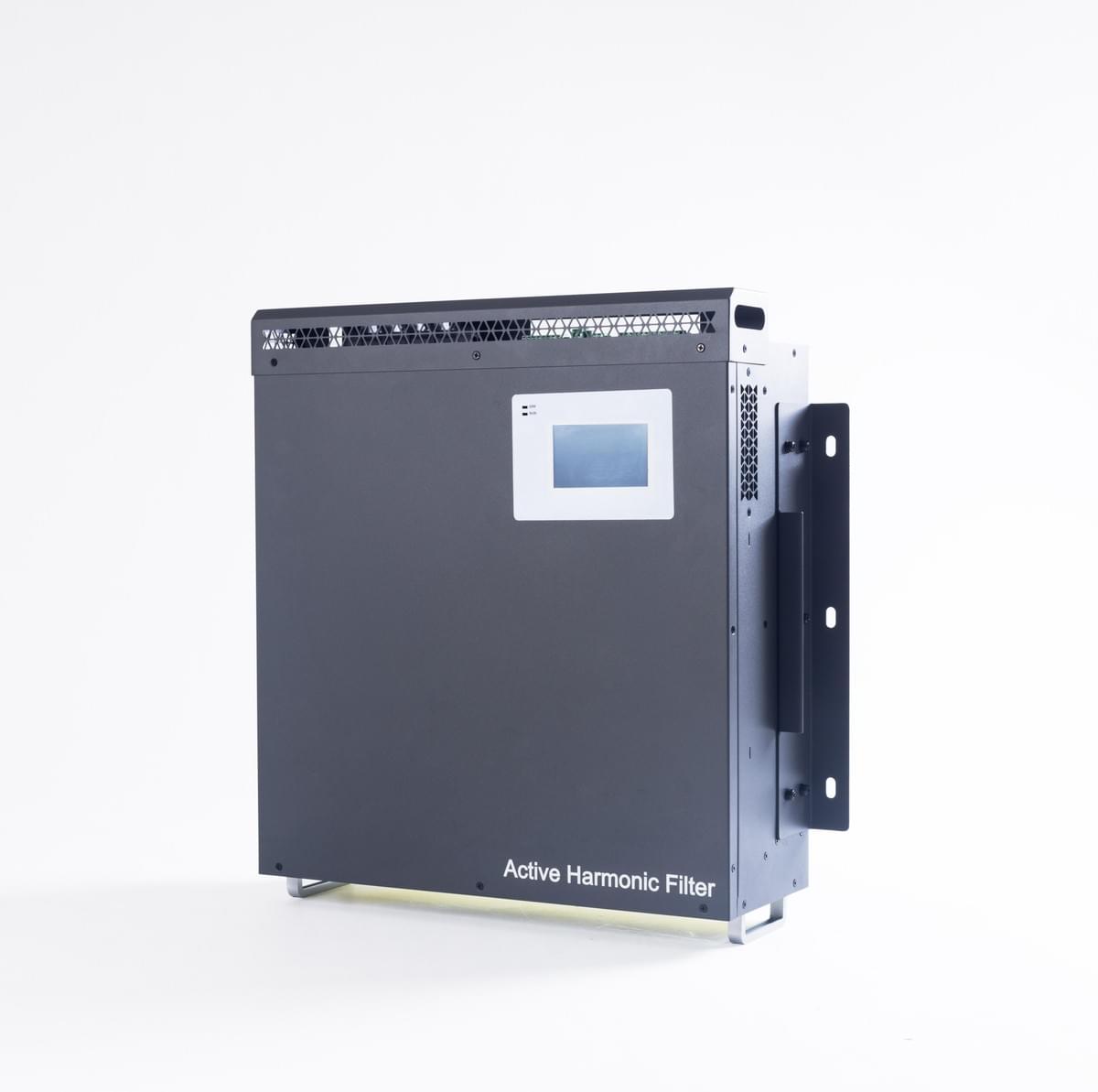
Within the HertzKron technical framework, the AHF (Active Harmonic Filter) Digital Signal Processor (DSP) utilizes coordinate transformation algorithms based on instantaneous reactive power theory. Through Clark and Park transformations, three-phase stationary coordinate signals are converted into a rotating coordinate system. This transformation converts complex AC harmonic components into algebraic indicators that are easy to calculate, precisely locking onto the frequency, magnitude, and phase of harmonics from the 2nd to the 50th order. Subsequently, the system generates a real-time instruction current signal that is equal in magnitude but opposite in phase to the detected harmonics. This microsecond-level computational response is the physical prerequisite for the "active" governance of an AHF (Active Harmonic Filter).
High-Frequency IGBT Power Modules Enable the Physical Generation of Mirror Compensation Currents
Once the digital instruction current signal is derived, the AHF (Active Harmonic Filter) must transform this abstract signal into a real-time current with physical energy. This core process is executed by the internal IGBT (Insulated Gate Bipolar Transistor) power conversion units.
The AHF (Active Harmonic Filter) leverages high-frequency Pulse Width Modulation (PWM) technology, controlling the IGBT to switch at tens of thousands of times per second. By adjusting the duty cycle, the system releases energy stored in the DC-link capacitors into the AC grid in a precisely controlled manner. This generated current is essentially a "mirror current": when a peak in the 5th or 7th harmonic is detected on the load side, the AHF (Active Harmonic Filter) produces a valley of identical depth at the exact same microsecond. This ability to simulate complex waveforms through high-speed semiconductor switching allows the AHF (Active Harmonic Filter) to counter extreme dynamic fluctuations generated by non-linear loads.
LCL Filter Topology Ensures Physical Isolation Between High-Frequency Ripple and the Power Grid
While high-frequency IGBT switching is key to generating compensation current, the switching action itself produces high-frequency switching noise. To ensure that the current injected into the grid is pure, a high-performance AHF (Active Harmonic Filter) must be configured with a precise LCL-type filter.
The LCL topology serves as the physical interface between the AHF (Active Harmonic Filter) and the grid, acting as a critical low-pass filter. It absorbs the ripples generated by the IGBT switching while ensuring the low-frequency compensation current passes through smoothly. In HertzKron engineering designs, LCL parameters are rigorously calculated to prevent resonance between the system impedance and the grid. This precision physical topology ensures that while the AHF filters out load harmonics, it introduces no new electromagnetic interference to the power system.
Destructive Interference Logic Realizes Physical Harmonic Cancellation at the Point of Common Coupling
The physical essence of harmonic mitigation by an AHF (Active Harmonic Filter) lies in the principle of Destructive Interference. When the generated compensation current is injected into the grid, it undergoes a physical superposition with the harmonic current produced by the load at the Point of Common Coupling (PCC).
Because the phase difference is precisely controlled at 180 degrees, the distorted harmonic currents are canceled out to zero at the injection point according to vector superposition principles. Consequently, the current waveform observed from the grid side (source side) is restored to a standard, pure sine wave. This "wave-against-wave" logic differs fundamentally from traditional passive LC filters, which create low-impedance paths to divert harmonics. The AHF (Active Harmonic Filter) acts as a controlled current source, achieving active purification across the entire harmonic spectrum without relying on fixed resonance points.
Dual Closed-Loop Feedback Control Ensures Balance Between Compensation Accuracy and Dynamic Performance
Grid load switching often occurs within a few cycles. To maintain stability in mitigation effects, the AHF (Active Harmonic Filter) employs a sophisticated dual closed-loop control logic: an external current loop tracks the harmonic instruction, while an internal voltage loop maintains the stability of the DC-link capacitor voltage.
After the compensation current is injected, the controller continuously monitors the residual harmonic content at microsecond intervals. If a sudden load change occurs—such as the rapid starting or stopping of variable frequency drives—the feedback loop immediately corrects the IGBT drive signals. This continuous "sampling-calculation-execution-correction" cycle allows the AHF (Active Harmonic Filter) to reduce Total Harmonic Distortion of current (THDi) from over 30% to below 5%. In the HertzKron logic, this closed-loop control is not only a guarantee of precision but also a safety barrier preventing power device overload.
HertzKron AHF Units Integrate Advanced SiC Technology and Modular Intelligent Thermal Management
In the competitive landscape of power quality, HertzKron AHF systems distinguish themselves through the integration of next-generation Silicon Carbide (SiC) components and intelligent modular design. Unlike standard units that suffer from thermal derating, HertzKron AHF modules utilize high-thermal-conductivity materials and independent air-duct cooling to maintain 100% compensation capacity even in high-ambient-temperature industrial environments.
The control architecture of a HertzKron AHF is designed for ultra-low impedance grids, featuring an adaptive impedance matching algorithm that prevents the system from entering "protective sleep" during grid fluctuations. By combining a 3nd-level inverter topology with a specialized "Hertz-Logic" noise reduction algorithm, HertzKron ensures that the harmonic mitigation is not just effective, but achieves the highest energy efficiency rating in the industry, significantly reducing the Total Cost of Ownership (TCO) for the end-user.
Dynamic Impedance Matching Renders the System Immune to Resonance Risks
Traditional capacitor banks often face the risk of parallel resonance when mitigating harmonics; if the system impedance matches the capacitor bank, harmonics can be amplified several times over. The AHF (Active Harmonic Filter) completely resolves this industry pain point.
Because the AHF (Active Harmonic Filter) behaves electrically as a controlled current source, its internal impedance is extremely high. This means it does not form a resonant circuit with inductive or capacitive loads in the system. Conversely, through optimized algorithms, the AHF (Active Harmonic Filter) can provide a damping effect, actively suppressing existing resonances within the system. This high degree of system compatibility and active defense makes it the ultimate solution for semiconductor fabs, data centers, hospitals, and any scenario with stringent power quality requirements.