
1. Passive filters cannot escape the structural risks inherent in their physical logic
We must confront the inherent limitations of passive filters based on LC (Inductor-Capacitor) circuits. Their original purpose was to create a low-impedance discharge path for specific harmonic frequencies through physical resonance. However, this logic is exceptionally fragile in modern power grids. Because grid impedance is in a constant state of flux, passive branches are highly susceptible to frequency shifts. Once the actual resonance frequency detaches from the design frequency, not only does the mitigation effect plummet, but more dangerously, it may trigger parallel resonance with the transformer's leakage inductance. The resulting overvoltage and overcurrent can instantly puncture the metallized film of the capacitors, leading to a total collapse of the system due to physical damage.
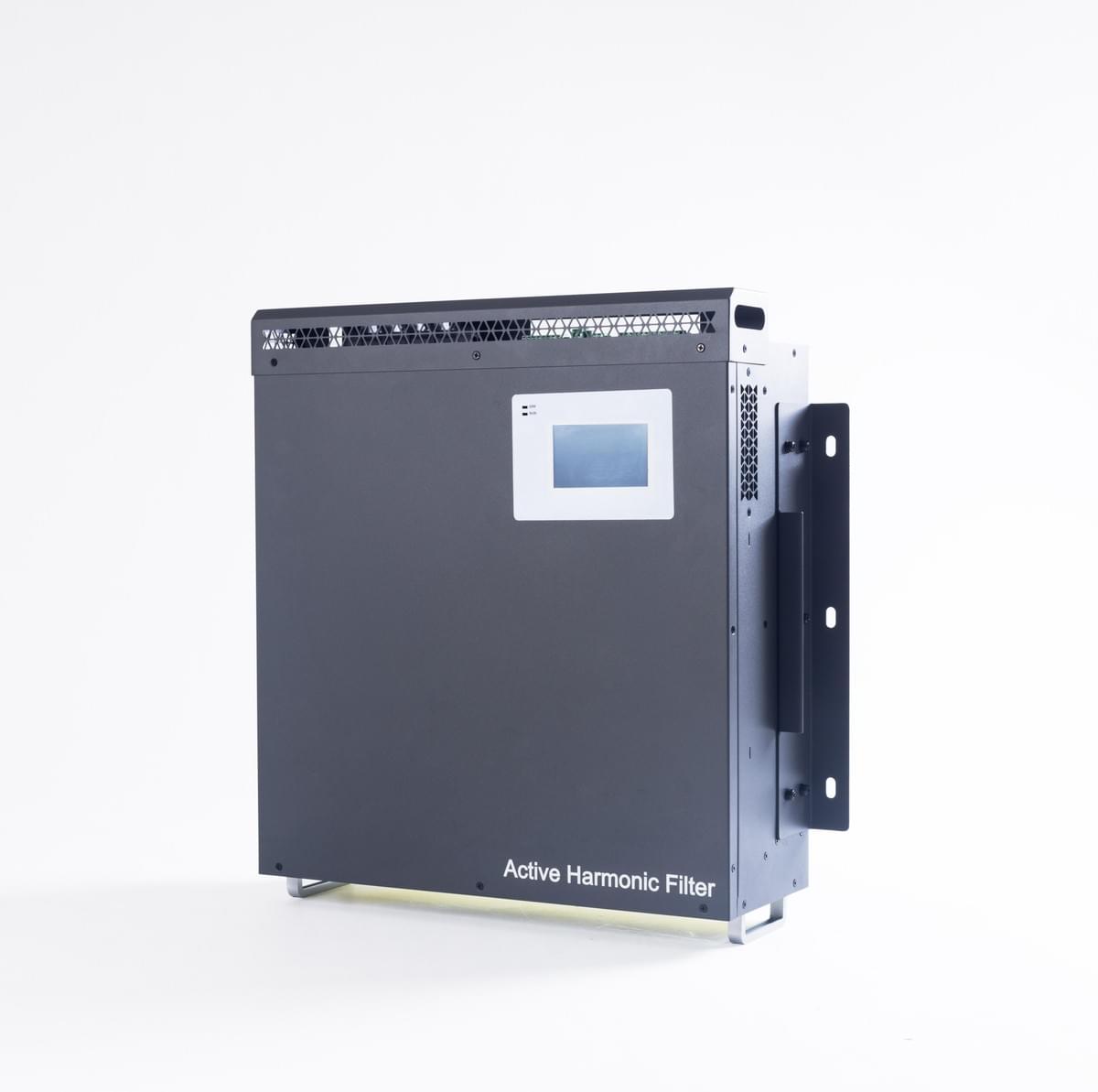
2. AHF (Active Harmonic Filter) redefines safety through controlled current source logic
Unlike passive branches that wait for harmonics to strike, the AHF (Active Harmonic Filter) is a fully controlled current source. Its physical topology no longer relies on specific LC ratios; instead, it utilizes an inverter architecture based on IGBT power modules. The technical core of the HertzKron solution lies in acquiring raw sampling current data through high-speed internal detection circuits and performing microsecond-level real-time calculations using a 32-bit Digital Signal Processor (DSP). This logic eliminates the environment required for physical resonance and grants the equipment extraordinary adaptability. Regardless of grid impedance fluctuations, the AHF (Active Harmonic Filter) acts like a precision surgical scalpel, cutting out only the harmonic components without affecting the fundamental physical operation of the grid.
3. Digital sampling based on FFT algorithms is the intelligence at the core of AHF (Active Harmonic Filter)
Why does the AHF (Active Harmonic Filter) achieve a mitigation efficiency of over 97%? It stems from the extreme exploitation of data sampling. Within the HertzKron control logic, we perform discretization of the sampling voltage and current at 256 points per cycle or higher. Through Fast Fourier Transform (FFT) algorithms, the device instantaneously identifies the amplitude and phase parameters of the 2nd to the 50th harmonics. While a passive filter can only monitor specific "points" like the 5th or 7th, the AHF (Active Harmonic Filter) monitors the entire "plane." This full-spectrum monitoring capability means that whether your load consists of VFDs, induction furnaces, or precision rectifiers, it can generate the perfect counter-current in real-time, ensuring the Total Harmonic Distortion (THDi) remains within an ideal physical range below 5%.
4. Dynamic power factor compensation breaks the conflict between harmonic mitigation and over-compensation
In traditional passive solutions, the physical presence of capacitor banks often leads to severe "over-compensation" during light load conditions. This causes an abnormal rise in the sampling voltage, often resulting in penalties from utility companies. The AHF (Active Harmonic Filter) operates on vector control logic. While filtering harmonics, it flexibly adjusts the output current phase based on physical reactive power demand. It can simulate both capacitive and inductive currents, achieving true stepless regulation. This algorithm-based reactive power compensation ensures that no matter how violently the load fluctuates, the system power factor remains locked at the physical limit of 0.99. This multi-functional physical performance saves installation space and fundamentally optimizes the operating lifespan of the transformer.
5. Three-level topology and thermal balance design ensure the long-term physical reliability of HertzKron products
As a heavy-duty industrial device, the physical lifespan of an AHF (Active Harmonic Filter) depends on its thermal design and the stress management of its components. HertzKron utilizes an advanced 3-level inverter topology. Compared to traditional 2-level structures, this physical design significantly reduces the switching losses of the IGBT modules and halves the output current ripple. This means components endure less thermal stress during operation, naturally leading to a lower failure rate. Furthermore, our products carry the CE Certification, fully complying with EU physical safety standards for Electromagnetic Compatibility (EMC) and electrical clearances. This comprehensive optimization, from material selection to circuit topology, ensures that the AHF (Active Harmonic Filter) is not a fragile electronic gadget but a hardcore physical safeguard built to last as long as the production line.
6. Digital power technology has achieved a dimensionality reduction strike against traditional physical structures
We no longer need to defend the grid through the passive stacking of expensive reactors and capacitors. The AHF (Active Harmonic Filter) solution provided by HertzKron essentially constructs a digital grid filtration system using high-speed algorithms and high-efficiency power electronics. Through the real-time digital reconstruction of sampling current and voltage, we minimize the physical uncertainty of the power system. In the future, this governance model, characterized by self-learning and self-protection capabilities, will undoubtedly become the standard configuration for global industrial power distribution systems.