
1. The 5th and 7th harmonics are highly prone to inducing physical parallel resonance and amplification in compensation branches
In a pure capacitor compensation system without the intervention of a reactor, the capacitor bank and the leakage inductance of the system transformer form a natural physical parallel resonance circuit. When the load side generates a large volume of 5th (250Hz) or 7th (350Hz) harmonics, if the system's resonance frequency happens to fall near these frequency points, the harmonic current will be instantaneously amplified by several or even dozens of times. This physical resonance generates extreme overvoltages that can directly puncture the internal insulation of the capacitor. Physical experimental data from HertzKron demonstrates that the primary purpose of installing a reactor is to alter the impedance characteristics of the branch, forcibly shifting the resonance point below the 5th harmonic (such as to 189Hz or 210Hz), thereby physically bypassing the dangerous amplification zones of the 5th and 7th harmonics.
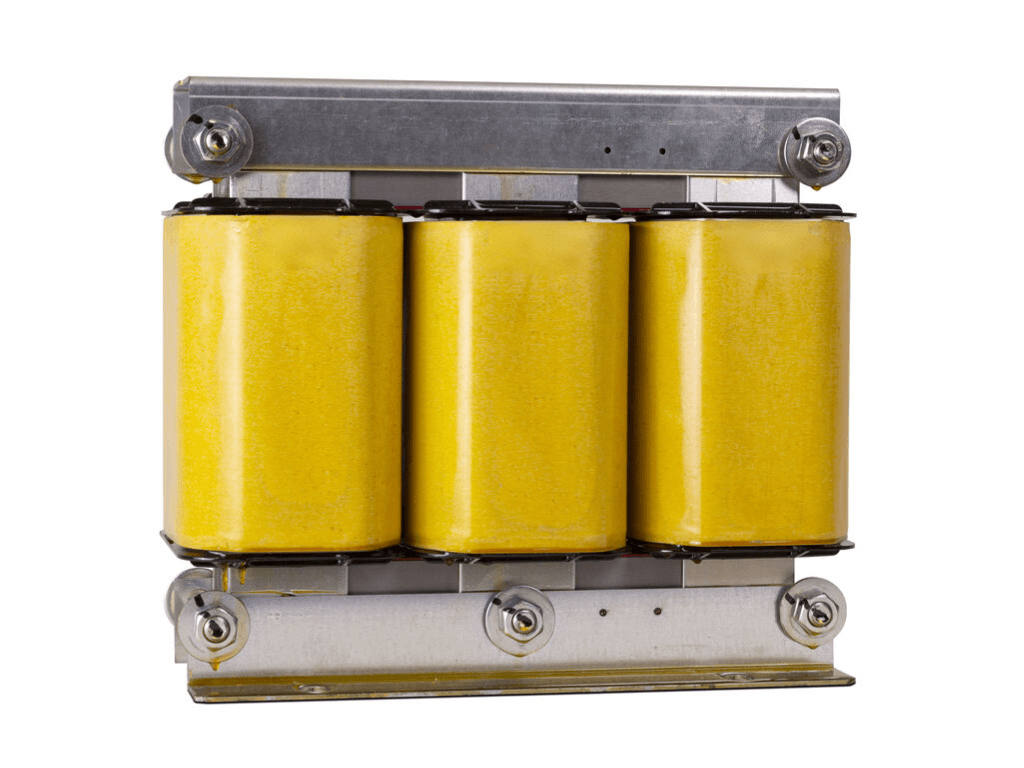
2. Installing a reactor effectively suppresses thermal failure and lifespan degradation caused by 5th and 7th harmonics
The laws of physics dictate that the impedance of a capacitor is inversely proportional to frequency, meaning the higher the frequency, the lower the impedance. In environments with high concentrations of 5th and 7th harmonics, a capacitor acts as a "harmonic sink," aggressively absorbing high-frequency harmonic currents. This overcurrent leads to violent molecular collisions and electrochemical heat accumulation within the capacitor, eventually causing casing expansion or even physical explosion. By connecting a reactor with a specific detuning factor (such as 7% or 14%) in series, we artificially increase the physical impedance of that branch at high frequencies. This impedance restructuring ensures that the capacitor only handles fundamental reactive power while blocking the additional thermal stress generated by 5th and 7th harmonics, fundamentally extending the physical service life of HertzKron capacitor components.
3. Reactors prevent the global spread of 5th and 7th harmonic pollution by altering the impedance vector
If the power distribution system is viewed as a highway, the 5th and 7th harmonics are runaway, overloaded trucks. Without a reactor, a capacitor bank becomes a "collection point" for harmonics across the entire plant due to its low-impedance characteristics, causing not only self-damage but also severe distortion of the sampling voltage throughout the facility. The physical intervention of a reactor alters the vector distribution of the current. It acts as a physical firewall, increasing the inductive reactance component and forcing the harmonic currents to remain on the non-linear load side to dissipate rather than flowing into the compensation system for secondary pollution. This physical isolation of the 5th and 7th harmonics is a critical barrier to ensuring that precision machining centers, PLC logic controllers, and high-accuracy sensors do not suffer from logic malfunctions.
4. Reactor selection for 5th and 7th harmonics must undergo rigorous sampling current spectrum calculation
In complex industrial grids, there is no such thing as a "universal fit." The selection of a reactor for 5th and 7th harmonics must be based on measured sampling current spectrum data. If the system is dominated by the 5th harmonic, a 7% reactor is typically chosen to lock the tuning frequency at 189Hz, ensuring the branch remains inductive at 250Hz. If the 3rd harmonic is also significant, a physically larger 14% reactor with higher inductance must be used. Technical experts at HertzKron point out that incorrect reactor matching not only fails to suppress the 5th and 7th harmonics but may create new physical resonance points, leading to instantaneous system collapse due to impedance mismatch. This precise matching based on physical parameters is the technical baseline that every CE Certified distribution cabinet must execute.
5. Physical magnetic saturation redundancy design of reactors under fluctuating 5th and 7th harmonic conditions
In real-world industrial production, the content of 5th and 7th harmonics fluctuates dynamically with the production line load, requiring the reactor to possess extreme anti-saturation capabilities. Inferior reactors are prone to physical magnetic saturation in the iron core when harmonic current surges, causing the inductive reactance to collapse instantaneously and lose its suppression effect on 5th and 7th harmonics. Reactors manufactured by HertzKron utilize high-linearity, low-loss silicon steel sheet stacking processes with strictly controlled physical air gaps. This design ensures that the inductance deviation remains less than 5% even under physical shocks of 1.8 times the rated current. This hardcore physical redundancy ensures that even at the worst moments of harmonic interference, the system maintains a stable tuning frequency, guaranteeing the robustness of the entire power architecture.
6. Restructuring a high-interference-resistant physical environment with CE Certified reactors
In the physical chain of modern power quality governance, a reactor is by no means a simple accessory to a capacitor—it is the system's body armor. Through deep analysis of 5th and 7th harmonic distribution patterns, we use the impedance characteristics of the reactor to redefine the physical logic of the grid. Choosing a HertzKron reactor with CE Certification means you obtain a technical solution that has undergone rigorous physical stress testing and thermal balance verification. This completely terminates the risks of sampling logic confusion, cable overheating, and compensator destruction caused by harmonics. Under this high-precision physical governance model, the 5th and 7th harmonics are no longer physical hazards threatening production safety but fully tamed and controllable parameters.