
In the heavy-duty world of the steel industry, power quality is the lifeblood of production. As your facility expands—adding Electric Arc Furnaces (EAF) or new rolling mills—the resulting harmonic pollution often surges past the capacity of your existing filtration systems.
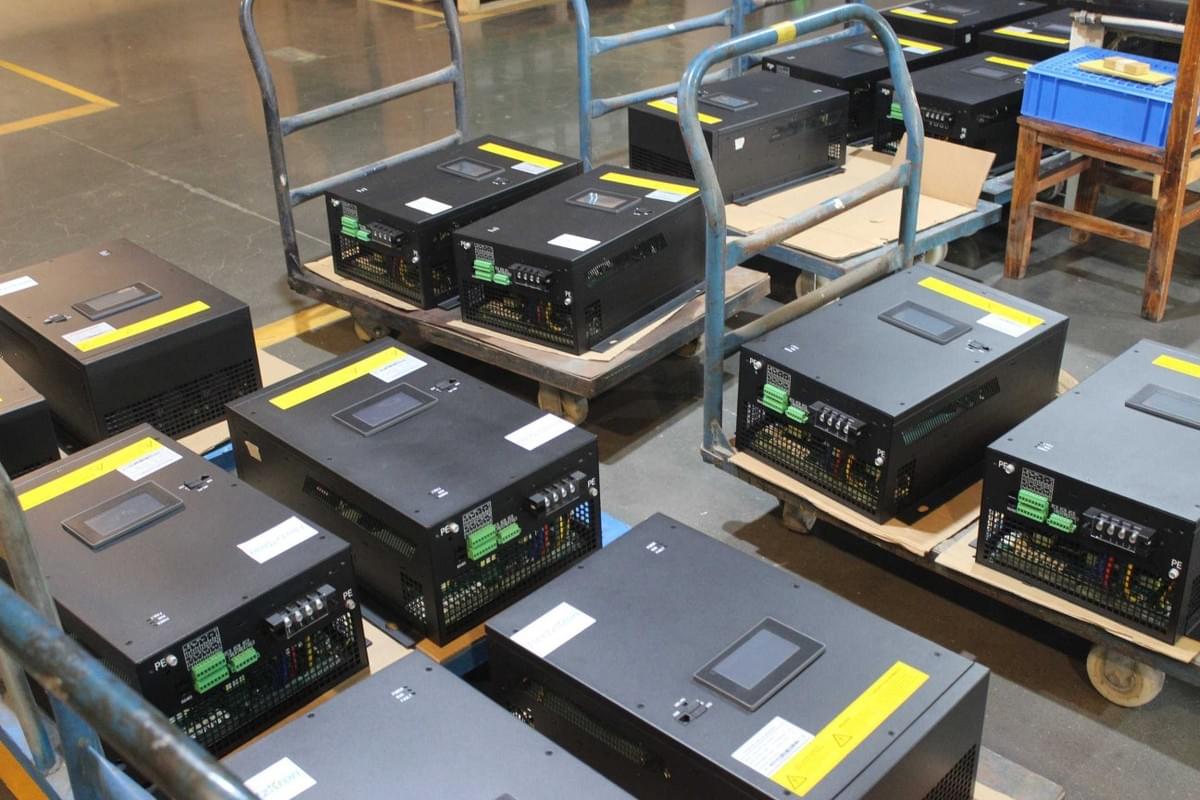
Many facility managers face a difficult dilemma: their reliable 200A Active Harmonic Filter (AHF) is now running at a constant 100% load, yet grid harmonics remain dangerously high.
Should you scrap the entire system, or is there a way to scale up?
Case Study: Scaling a Steel Plant Capacity from 200A to 400A
Recently, a leading steel manufacturer in Iran encountered this exact bottleneck. Their original Hertzkron 200A AHF module was performing with high stability, but as plant demand increased, a single unit could no longer meet the required mitigation standards.
Instead of a costly and complex total system replacement, we implemented a strategic Master-Slave Synchronization solution. By simply adding a second Hertzkron 200A module, the plant successfully doubled its compensation capacity to 400A without altering the existing power distribution architecture.
Why Master-Slave Sync is Critical for Heavy Industry
In a steel plant environment, harmonics are more than just an efficiency issue; they cause transformer overheating and trigger malfunctions in sensitive control electronics. The Hertzkron parallel logic provides three core advantages:
- Intelligent Load Distribution: The Master unit monitors the grid in real-time and intelligently assigns the compensation load to the Slave unit, ensuring no single module is overstressed during peak production.
- Seamless Synchronization: Connected via a dedicated shielded communication link, the two units operate as a single, synchronized 400A engine, eliminating oscillations or phase interference between modules.
- Modular Resilience: In the high-temperature, high-dust environments typical of steel manufacturing, modularity provides safety. If one module requires maintenance, the other continues to provide baseline protection, ensuring the production line stays active.
Simple Setup for Complex Environments
For on-site engineers, the expansion process is remarkably intuitive:
- Hardware Connection: Link the two AHF modules using a dedicated communication cable between the controller ports.
- Software Configuration: Simply designate one unit as "Master" and the other as "Slave" via the HMI touchscreen.
- System Optimization: The system automatically harmonizes parameters to achieve efficient 400A parallel operation.
Protect Your Investment with Hertzkron
At Hertzkron, we believe your power quality solution should evolve alongside your business growth. Whether you are operating a single 200A module or a synchronized multi-unit array in a massive industrial facility, our technology ensures your grid remains clean, stable, and efficient.
Is your current AHF system struggling to keep pace with your plant’s expansion?Contact our technical team today for a customized expansion roadmap and see how easily you can upgrade your grid through Master-Slave synchronization.