
In modern industrial power distribution systems, the Capacitor is usually seen as the protagonist of Reactive Power Compensation. However, with the surge of non-linear loads, the grid environment has become increasingly harsh. If we compare the Capacitor to an "Energy Source" that provides power, then the Power Reactor is the stern, professional "Security Guard" of the system.
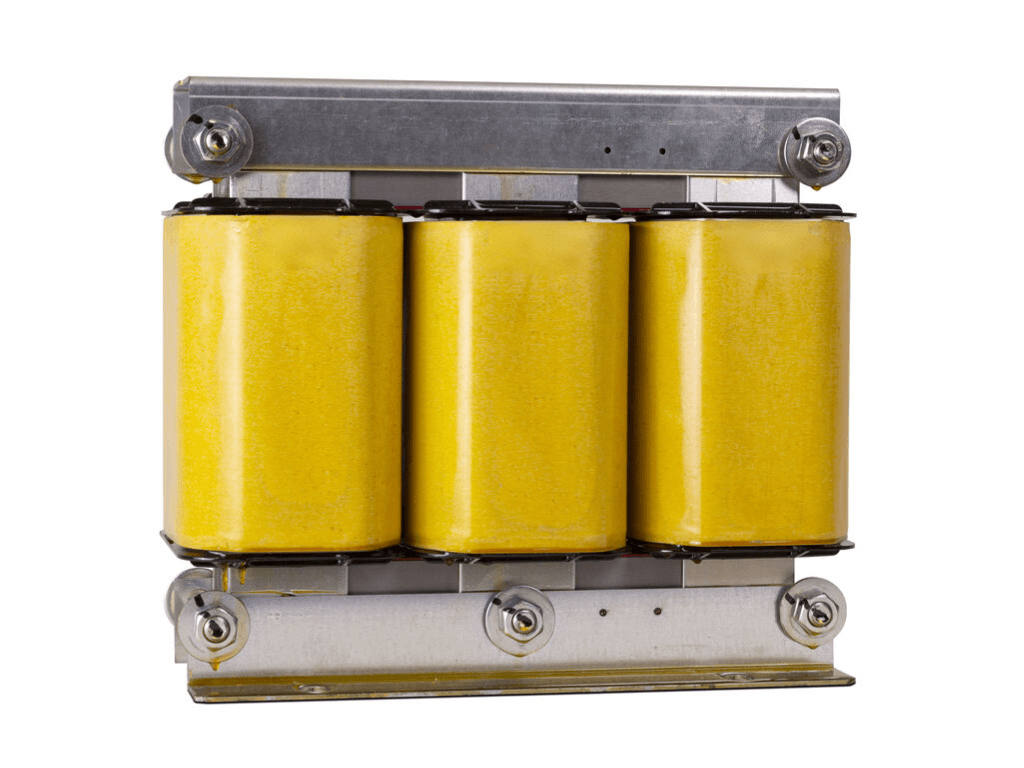
Without the protection of a Reactor, Capacitor banks often fall victim to grid Harmonics, sometimes triggering severe electrical accidents. As core engineers at HertzKron, we always emphasize to our clients: understanding the "Security Guard" role of the Reactor is the first step in building a high-resilience power system.
1. The Source: The Physical Essence of a Power Reactor
From a physical construction perspective, a Power Reactor is essentially an inductive load with a significant Inductance value. It consists of conductive wire windings and a magnetic circuit (either an iron core or an air core). In an AC circuit, the Reactor exists not just to increase Impedance, but to utilize its Inductive Reactance properties to balance the Capacitive Reactance within the system.
In the HertzKron product lineup, the Reactor is defined by precise Impedance parameters. It is not a simple collection of coils; it is a grid-control component crafted through the meticulous calculation of Magnetic Saturation strength, Linearity, and Thermal Capacity.
2. Role Decomposition: Why is the Reactor the "Security Guard"?
Inside a Reactive Power Compensation cabinet, the Reactor is typically connected in a Series Connection with the Capacitor. This seemingly simple combination actually forms four lines of defense for grid safety.
I. The First Line of Defense: The Harmonic "Filter"
Modern factories are full of Variable Frequency Drives (VFDs), DC motors, and rectifiers. These devices generate massive amounts of Harmonic Current during operation. Since a Capacitor has extremely low Impedance toward high-frequency signals, Harmonics will rush toward the Capacitor like a flood, causing it to overheat or even explode.The Security Duty: By connecting a Reactor with a specific Reactor Rate (such as 7% or 14%) in series, the circuit formed by the Reactor and Capacitor generates high Impedance against specific Harmonic frequencies. This acts as a "shield," blocking Harmonic Current from entering the Capacitor.
II. The Second Line of Defense: The Resonance "Bomb Disposal Expert"
When the Inductive Reactance of the grid system equals the Capacitive Reactance of the Capacitor at a certain frequency, a terrifying phenomenon called Parallel Resonance occurs. Resonance can instantaneously amplify Current and Voltage by several or even dozens of times.The Security Duty: The Reactor shifts the resonance point of the compensation branch, moving it away from the Harmonic frequencies present in the grid. HertzKron reactors undergo strict parameter matching to lock the Tuning Frequency within a safe range, physically dismantling the "time bomb" of resonance.
III. The Third Line of Defense: The Inrush Current "Shock Absorber"
At the moment a Capacitor is switched into the grid, because the Voltage across its terminals cannot change abruptly, a massive Inrush Current is generated, with an Amplitude that can reach a hundred times the Rated Current.The Security Duty: Due to the physical property of Inductance that opposes changes in Current, the Reactor effectively suppresses the rate of change of the Current. It acts like a giant spring, buffering the energy impact at the moment of closing and protecting the Contactor contacts and the grid from transient shocks.
IV. The Fourth Line of Defense: The "Life Extender" for Capacitors
Long-term exposure to an unclean, harmonic-laden Voltage environment accelerates the aging of the internal dielectric of a Capacitor.The Security Duty: By improving the Current waveform entering the Capacitor, the Reactor significantly reduces the Temperature Rise and Voltage stress on the Capacitor, thereby extending its Electrical Life.
3. Technical Trade-offs: 7% or 14%? Precise Selection of Reactor Rate
As a professional "Security Guard," the Reactor must be equipped according to the specific "crime rate" (grid background).
- 7% Reactor Rate: Primarily targeted at environments with high 5th-order and higher Harmonics. In most factories where VFDs and rectifiers are prevalent, 7% is the balanced configuration recommended by HertzKron. It effectively suppresses Capacitor overload caused by 5th-order and higher Harmonics.
- 14% Reactor Rate: Specifically designed for sites with severe 3rd-order Harmonics. Examples include commercial complexes with LED lighting and office buildings with many single-phase switching power supplies. These 3rd-order Harmonics add up on the neutral line, and only a high Reactor Rate can provide sufficient Impedance protection.
4. Engineering Standards of HertzKron Reactors
At HertzKron, we set extremely high standards for this "Security Guard":
- High Linearity: The Reactor must not reach Magnetic Saturation during Overload Current conditions. Once saturated, the Inductance value drops sharply, and the compensation branch loses its protection. Our reactors maintain stable Inductive Reactance even at 1.8 times the Rated Current.
- Low Loss: Reactors generate heat during operation. By optimizing iron core materials and winding structures, we control the Temperature Rise well below national standards, ensuring the safety of the environment inside the distribution cabinet.
- Noise Control: Utilizing a special vacuum impregnation process, we effectively reduce the vibration and humming of the Reactor under the alternating magnetic field, meeting the silence requirements of residential and office locations.
5. Case Study: Consequences of a Missing "Security Guard"
In a distribution renovation project for a chemical plant, a client removed the Reactors from the Reactive Power Compensation cabinets to save costs, leaving only the Capacitors directly connected to the grid.Within less than three months of operation, multiple power outages occurred. HertzKron technicians found that because of the high number of VFDs in the workshop, 5th-order Harmonics were amplified nearly 10 times in the Capacitor branch. This caused all Capacitor banks to bulge and fail, and the main switch tripped frequently due to overcurrent protection triggered by Harmonics.Conclusion: Without a Reactor's protection, a Capacitor is a "sitting duck" exposed to harmonic fire. After re-configuring with HertzKron specialized filtering reactors, the system Power Factor stabilized at 0.98, and the THDi (Total Harmonic Distortion - Current) dropped by 60%, with zero failures since.
6. Conclusion: The Invisible Hero of the Power System
The Power Reactor may not have the complex digital panels or flashy technical names of an AHF or SVG, but it is rooted in the fundamental layer of physical Impedance, silently guarding the safety of every Capacitor.
In the vision of HertzKron, excellent engineering design is a combination of redundancy and precision. Choosing the right Reactor is like hiring a top-tier "Security Guard" for your power system. It rarely speaks, but in moments of crisis, it is the final line of defense.