
In the industrial electrical sector, Reactive Power Compensation has always been the cornerstone of ensuring power supply efficiency and optimizing electricity expenses. However, as industrial loads transition from simple inductive motors to precision variable frequency drives and non-linear systems, traditional compensation methods have begun to show their limitations.
As the core technical team at HertzKron, we are frequently asked a fundamental question: Since traditional Capacitor banks (SVC) are lower in cost, why are high-end manufacturing, renewable energy, and precision data centers worldwide shifting toward SVG (Static Var Generator)?
To answer this, we must look past commercial parameters and dive into the underlying logic of electromagnetic physics and power electronics. This article will provide a deep dive into the essential differences between the SVG (Static Var Generator) and the SVC (Static Var Compensator).
1. The Source: What is the Physical Essence of Reactive Power Compensation?
In an AC grid, Reactive Power is not "useless" energy. It is the carrier of energy exchange required to establish electromagnetic fields and maintain the operation of Transformers and Motors. However, when reactive Current flows back and forth in the grid, it occupies the effective Capacity of cables and Transformers, creating unnecessary Voltage Drop and Heat Loss.
The so-called "compensation" is essentially providing a local "energy buffer" at the load end to offset the Reactive Power demand from the main grid.
- SVC (Static Var Compensator - Traditional Passive Compensation): Essentially an "Impedance-type device." It switches physical Capacitors or Reactors via Contactors or Thyristors, attempting to balance the grid by canceling out Inductive Reactance with Capacitive Reactance.
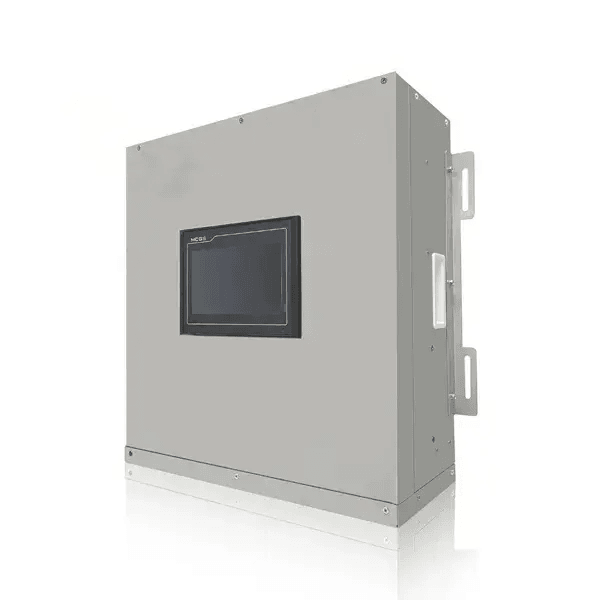
- HertzKron SVG (Static Var Generator): Essentially a "Controlled Voltage Source." It no longer relies on bulky Capacitors or Reactors for energy storage. Instead, it uses power electronic inverter technology to actively generate a compensation Current that perfectly matches the load demand.
2. Core Difference I: The Performance Leap from Impedance Regulation to Voltage Source Inversion
This is the most fundamental difference between the SVG (Static Var Generator) and traditional compensation schemes.
The Limitation of SVC: Passive Dependence on Grid Voltage
The Reactive Power produced by traditional Capacitor banks is proportional to the square of the system Voltage. The calculation involves Voltage, Angular Frequency, and Capacitance. This means that when the grid Voltage drops due to load fluctuations, the compensation capability of the Capacitor shrinks exponentially. At the very moment the grid needs support the most, the SVC often lacks the "strength" to deliver.
The Advantage of HertzKron SVG: Absolute Active Control
The SVG utilizes a self-commutating bridge circuit. By adjusting the Phase and Amplitude of the inverter's output Voltage, it can directly control the nature of the output Current. Regardless of grid Voltage fluctuations, the HertzKron SVG acts as a Constant Current Source—even if the system Voltage drops to extremely low levels, it can still output its rated Reactive Current. This robust support capability is a technical chasm that traditional SVCs cannot cross.
3. Core Difference II: Millisecond Response Speed vs. Sluggish Mechanical Action
For modern precision factories (such as semiconductor lithography or precision welding), instantaneous Voltage Sag is the primary cause of production downtime.
- The Lag of SVC: Even with Thyristor Switched Capacitors (TSC), the Response Time is typically between 20 Milliseconds and 200 Milliseconds. Older Capacitor banks using Contactors are even worse; due to the need for the Capacitor to Discharge, the delay for re-switching can often last several seconds or even minutes. This speed is "too little, too late" for transient impact loads.
- The Instantaneous Response of HertzKron SVG: Because the internal system is driven entirely by high-frequency switching IGBTs, the total Response Time of the SVG is typically less than 5 Milliseconds. This microsecond-level sensing and decision-making capability can instantly suppress Voltage Flicker caused by sharp load changes, ensuring expensive precision equipment passes through grid fluctuations with "zero perception."
4. Core Difference III: Linear Stepless Compensation vs. Stepped Incremental Compensation
The accuracy of Power Factor regulation determines the limit of electricity cost savings.
Traditional SVC (Static Var Compensator) can only switch in steps based on the individual Capacity of the Capacitors. If you need 12kvar of compensation, but the Capacitor bank only has 10kvar and 20kvar steps, you are forced to choose between Under-compensation or Over-compensation. This stepped logic often causes the Power Factor to bounce between 0.85 and 0.95, failing to achieve a perfect balance.
The HertzKron SVG (Static Var Generator) achieves true linear continuous regulation. The smooth transition from Inductive to Capacitive means it can compensate accurately to three decimal places, maintaining the Power Factor at an ideal level of 0.99 or even 1.0 over the long term, helping enterprises completely eliminate Power Factor penalties.
5. Core Difference IV: Survival Rules in Harmonic Environments
This is the safety baseline that the HertzKron brand focuses on most during product design.
In environments with high levels of Harmonics from Inverters and DC Motors, the Capacitor bank of an SVC acts like a "Harmonic Magnet." Because the Impedance of a Capacitor is extremely low for high-frequency Harmonics, it easily triggers harmonic amplification or even Parallel Resonance. This is the hidden cause behind many mysterious Capacitor cabinet fires or explosions in factories.
The SVG (Static Var Generator) completely avoids this risk. Since it does not contain large parallel Capacitor banks, the SVG itself presents extremely high output Impedance. Not only does it not trigger resonance, but it can also actively inject reverse harmonic Current, acting similarly to an AHF (Active Harmonic Filter) for partial mitigation. This "Harmonic Immunity" ensures that HertzKron SVGs remain stable even under harsh operating conditions.
6. Industry Application and HertzKron Engineering Practice
At HertzKron, we don't just manufacture equipment; we build high-resilience energy systems for our clients.
- Data Centers (IDC): Modern UPS systems often generate leading Capacitive Reactive Power. Traditional SVCs can only compensate for Inductive loads and are helpless here. The HertzKron SVG possesses bi-directional regulation capability, effectively solving generator oscillation issues.
- Renewable Energy (Solar and Wind): Voltage fluctuations at new energy sites are violent and the Frequency is inconsistent. The fast Voltage support capability of the SVG is the only choice for grid compliance.
- Steel and Heavy Industry: Facing Voltage Flicker from electric arc furnaces, the SVG can instantly compensate for dynamic fluctuations, improving Power Quality efficiency.
7. Conclusion: Why HertzKron SVG is a Future-Proof Investment
While the initial procurement cost of an SVG (Static Var Generator) is slightly higher than a traditional SVC (Static Var Compensator), the perspective changes when looking at the full life cycle of the equipment:
- Space Efficiency: The power density of an SVG is massive. The modular design saves approximately 50% of the floor space compared to traditional Capacitor cabinets.
- Maintenance Costs: With no aging Capacitors, the IGBT has a service life of over 10 years, drastically reducing operational expenses.
- Efficiency Gains: Extreme Power Factor control means lower Line Loss and the total disappearance of electricity penalties.
HertzKron believes that excellent industrial design is a product of rigorous logic. The leap from SVC to SVG is not just a technological iteration; it is an elevation of our commitment to Power Quality, production safety, and green energy.