
In the era of Industry 4.0, power quality is no longer just a secondary technical metric; it is a core competitive factor that directly impacts production continuity, equipment lifespan, and energy costs. As global manufacturing shifts toward automation and digitalization, the proportion of non-linear loads in power grids has exploded.
As a professional brand deeply rooted in the power compensation industry, HertzKron adheres to First Principles Thinking to re-examine the essence of grid pollution. We have found that traditional passive compensation methods often fall short when faced with high-frequency, high-dynamic harmonic interference. This is where the AHF (Active Harmonic Filter)—a power quality governance terminal with "active intelligence"—emerges as the ultimate solution for complex grid challenges.
1. The Source: Why Do We Need an AHF (Active Harmonic Filter)?
To understand the necessity of an AHF, one must first analyze the physical origin of harmonics. In an ideal world of sine waves, current and voltage fluctuate along a perfectly smooth curve over time. However, modern industry relies heavily on non-linear loads such as rectifiers, switching power supplies, Variable Frequency Drives (VFDs), and electric arc furnaces.

These loads do not draw current continuously; instead, they draw power in fragmented, pulse-like waveforms. According to Fourier Series analysis, any distorted periodic waveform can be decomposed into a fundamental frequency (50Hz or 60Hz) and a series of harmonic components that are integer multiples of that fundamental frequency.
These harmonic components flowing through the grid lead to several fatal consequences:
- Skin Effect in Transformers and Cables: Higher harmonic frequencies reduce the effective conductive area of wires, leading to abnormal heat generation and shortened insulation life.
- Precision Logic Errors: For semiconductor production lines or automated robots, tiny voltage distortions can cause control signal chaos, triggering unplanned downtime.
- Capacitor Bank Rupture: Traditional compensation capacitors present low impedance to high-frequency harmonics, making them prone to absorbing harmonic currents, which leads to overloading or parallel resonance.
2. Core Mechanism: The Active Governance Logic of HertzKron AHF
The core competitiveness of an AHF (Active Harmonic Filter) lies in its "Active" attribute. Unlike traditional filter networks that rely on the physical properties of capacitors and inductors, the HertzKron AHF is a sophisticated, controlled current source system.
A. Millisecond-Level Real-Time Sensing
At the intake end of the AHF, high-sampling-rate Current Transformers (CTs) are deployed. Acting like a 24-hour surveillance probe, they capture every minute fluctuation of the current waveform at a frequency of tens of thousands of times per second. The HertzKron algorithm center decomposes the real-time current in microseconds using Instantaneous Reactive Power Theory (p-q Theory).
B. High-Computing Logic Decision Layer
The sensed signals are sent to the "brain" of the AHF—a high-performance Digital Signal Processor (DSP) and a Field Programmable Gate Array (FPGA). Here, the system not only calculates the Total Harmonic Distortion (THDi) but also precisely separates the phase and amplitude of each harmonic order from the 2nd to the 50th. This computational density ensures that even during sudden load changes, the HertzKron AHF can make accurate predictions.
C. Powerful Executive Layer
Once the command is issued, the internal power modules—based on top-tier IGBT (Insulated Gate Bipolar Transistor) technology—react instantly. Utilizing the energy stored in the DC-side capacitors, the inverter bridge generates a compensation current that is exactly opposite in phase (180 degrees out of phase) and identical in magnitude to the detected harmonic current.
D. Physical Energy Cancellation
When this compensation current is injected into the grid, it undergoes physical destructive interference with the harmonic current generated by the load at the Point of Common Coupling (PCC). From the transformer output side, the distorted current waveform is "trimmed" back into a perfect sine wave. This process is akin to wearing "Active Noise-Cancelling Headphones" in a loud environment—eliminating the noise and leaving only the pure melody of the fundamental frequency.
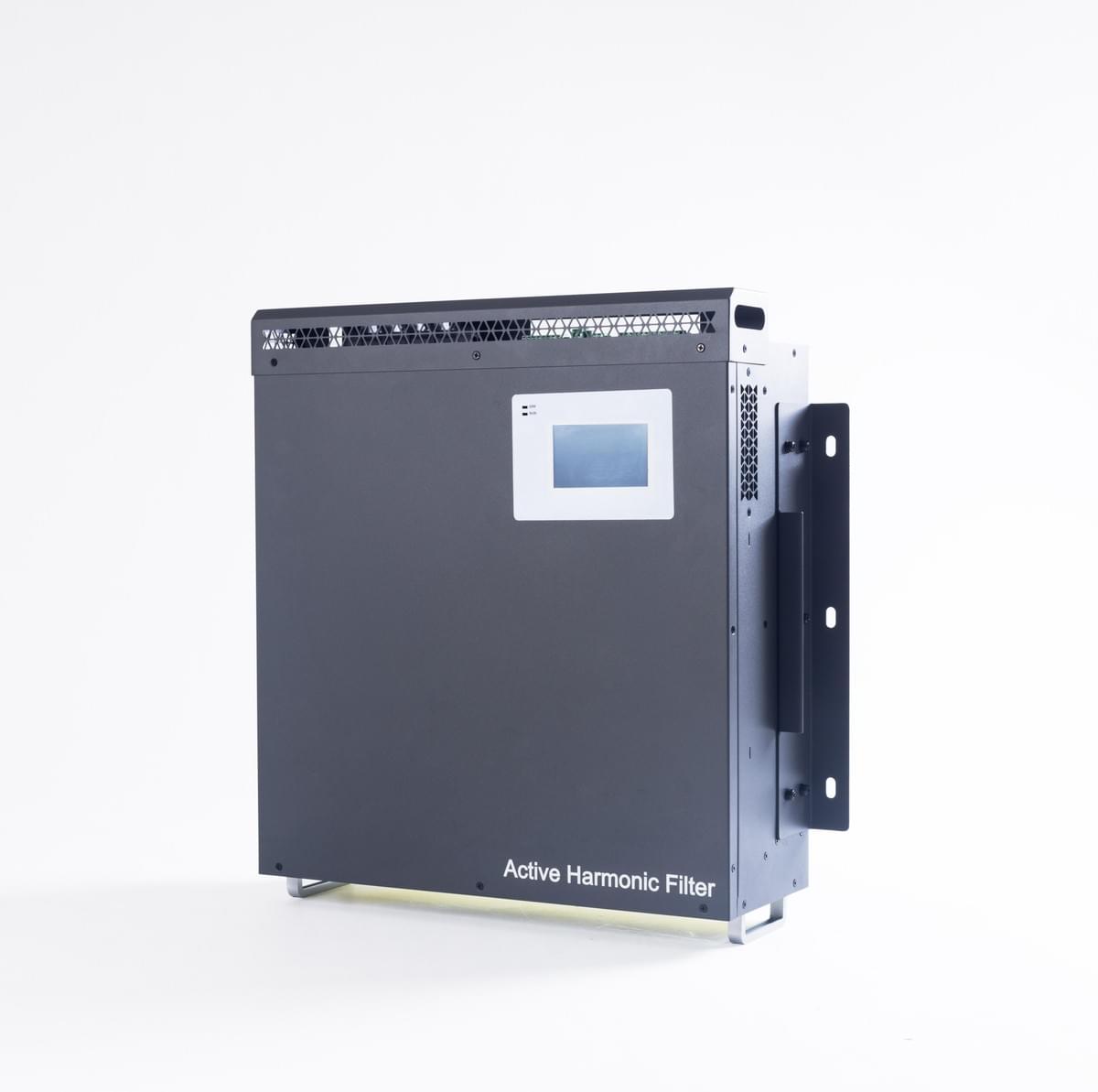
3. Technical Rivalry: AHF (Active Harmonic Filter) vs. Passive Filters
During project selection, many users focus on initial cost. However, HertzKron always reminds clients: the initial purchase price is just the tip of the iceberg. The operational stability and governance effectiveness over the full life cycle represent the true ROI (Return on Investment).
I. Breadth of Filtering Range
Traditional Passive Filters (LC filters) are typically tuned only for specific orders (e.g., 5th or 7th). However, modern factory harmonic profiles are dynamic. If a production line adds single-phase loads, 3rd harmonics may surge; if a VFD is replaced, the harmonic spectrum may shift. Passive filters are helpless against these changes, whereas an AHF (Active Harmonic Filter) provides full-spectrum coverage from the 2nd to the 50th order, solving all frequency interference with a single machine.
II. Avoiding Resonance Risks
This is the most critical safety difference. Passive filters are essentially connected in parallel with the system impedance. When system parameters change, parallel or series resonance can easily occur, leading to capacitor burnout or even distribution cabinet fires. The HertzKron AHF, acting as a controlled current source, has extremely high output impedance, theoretically eliminating resonance risks from a physics perspective.
III. Flexibility in Reactive Power Compensation
While the primary job of an AHF is harmonic mitigation, it also possesses powerful reactive power compensation capabilities. Unlike capacitors, which can only compensate for inductive reactive power, an AHF can achieve bi-directional continuous adjustment of both inductive and capacitive power. This means that even in environments like data centers, which produce large amounts of leading (capacitive) reactive power, the AHF can precisely maintain the power factor at 0.99.
4. Industry Applications: Where Does the HertzKron AHF Excel?
A. Semiconductor and Precision Manufacturing: Protecting "Micron-Level" Accuracy
In semiconductor etching or wafer testing lines, even a ten-thousandth of a second of voltage fluctuation can result in the scrapping of silicon wafers worth tens of thousands of dollars. The HertzKron AHF eliminates high-frequency interference noise by filtering harmonics, providing a "laboratory-grade" pure power environment for precision manufacturing.
B. Modern Data Centers (IDC): The Ultimate Savior of Neutral Currents
In IDC rooms, thousands of switching power supplies for servers generate massive amounts of 3rd-order harmonics. Since 3rd harmonics are additive in the neutral conductor, this often causes the neutral current to exceed the phase current, leading to severe cable overheating. By deploying the HertzKron three-phase four-wire AHF, we effectively cancel the harmonic current on the neutral line, reducing fire hazards to zero.
C. Healthcare Facilities: Stability for Precision Imaging
MRI and CT scanners in hospitals are extremely sensitive to power quality. Harmonics not only shorten the lifespan of expensive vacuum tubes in these multi-million dollar machines but also interfere with imaging clarity, leading to misdiagnosis risks. Applying an AHF here is not just about protecting assets; it’s about protecting lives.
5. The HertzKron First Principle: Why Choose Us?
At the core of the HertzKron brand, we are not satisfied with just manufacturing a machine. We pursue the ultimate in engineering aesthetics and reliability.
- Modular Design: Our AHFs utilize a high-power-density modular structure. This means you can increase compensation capacity dynamically—like stacking blocks—as your factory expands. Furthermore, a single module failure does not affect the overall system operation, greatly reducing maintenance costs.
- 3-Level Inverter Technology: Compared to traditional 2-level structures, the 3-Level technology adopted by HertzKron produces a finer current gradient, resulting in lower switching losses and higher filtering efficiency.
- Smart Energy Monitoring: Every HertzKron AHF is equipped with standard RS485 or Ethernet interfaces, supporting the Modbus communication protocol. You can monitor the harmonic distribution, reactive power consumption, and energy-saving data of the entire plant in real-time via mobile or PC, achieving a truly "Transparent Grid."
6. Conclusion: The Choice for a Future-Ready Power Grid
Under the dual drivers of energy structure transformation and industrial automation, grid purification is no longer a one-time "renovation" but a continuous "health maintenance" task.
The HertzKron AHF (Active Harmonic Filter) represents the pinnacle of current power electronics technology. It not only saves you money on electricity bills by improving the power factor but, more importantly, it builds an indestructible protective wall for your expensive production equipment by eliminating harmonic pollution.
On the future path of power quality governance, HertzKron will continue to uphold rigorous logic and an innovative spirit, helping every enterprise achieve a more efficient, greener, and purer energy future.