
In the field of low-voltage power factor correction (PFC), a capacitor's shape is closely tied to its internal structure, heat dissipation requirements, and manufacturing processes. This is not merely a difference in aesthetics, but a result of balancing electrical performance and economic efficiency.
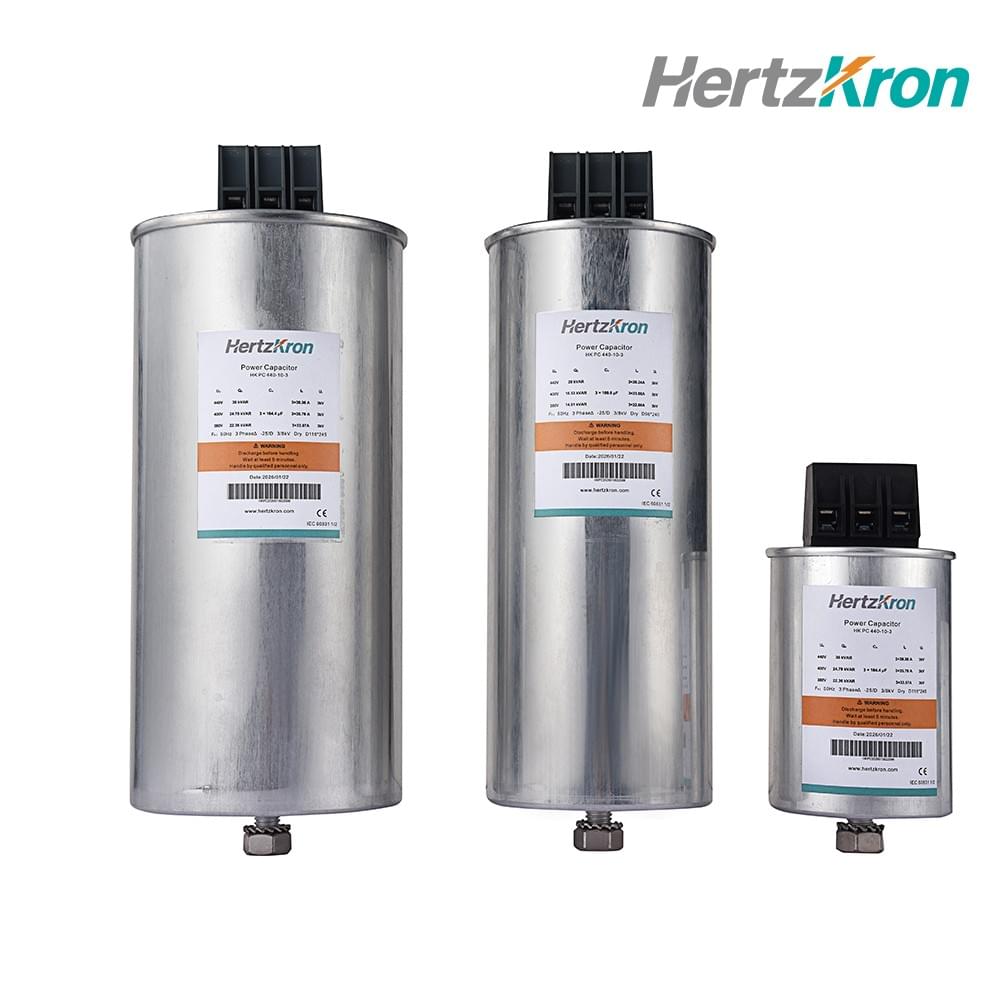
When meticulous electrical engineers review the product manuals of major reactive power compensation brands, they always notice an interesting industry convention: for capacities below 50kvar, capacitors are almost exclusively designed with cylindrical aluminum shells; once they exceed 50kvar—especially reaching 60kvar, 80kvar, or higher—the product form universally shifts to a steady, heavy-duty box-type (rectangular) iron casing.
How exactly was this invisible "50kvar watershed" formed? When performing R&D and model selection, how should we understand the technical logic behind these two distinct physical forms?
1. Below 50kvar: The Ultimate Cost-Efficiency and Safety Aesthetics of Cylindrical Designs
For small-to-medium capacity reactive power compensation applications, the cylindrical capacitor is undoubtedly a masterpiece of modern industrial manufacturing. Generally wound from metallized polypropylene film (MKP), it strikes a perfect balance among efficiency, safety, and cost.
1. The Economy of Automated Winding
The core of the cylinder lies in the "roll." On modern production lines, high-precision automated winding machines can rapidly spin two layers of metallized film into a compact cylinder. This process is highly continuous and yields excellent pass rates, significantly driving down single-unit manufacturing costs. For highly standardized products like 10kvar–30kvar units that face massive demand, the cylindrical shape offers an unparalleled cost advantage.
2. Perfect Mechanical Pressure Resistance and Explosion-Proof Design
According to mechanical principles, when internal pressure builds up inside an object, a cylindrical shell distributes the stress most evenly, leaving no structural dead zones. This characteristic provides the perfect foundation for the cylindrical capacitor's core safety mechanism: the Overpressure Disconnector.When a capacitor generates trace amounts of gas due to overload or film aging—causing internal pressure to rise—the top of the aluminum shell expands upward along a pre-scored groove. This physical expansion pulls apart and breaks the internal connecting wires, achieving an instantaneous disconnect. This explosion-proof design is simple, reliable, and highly cost-effective.
3. Short Heat Dissipation Paths and Compact Layouts
The internal winding cores of small-to-medium capacity capacitors have relatively small diameters, meaning the path for heat to travel from the center to the outer aluminum shell is incredibly short. Combined with the enclosure's airflow channels, cylindrical units can be arranged in tight, matrix-like layouts inside the compensation cabinet. This not only saves valuable footprint but also leverages the natural gaps between the cylinders to create effective air convection channels.
2. Above 50kvar: The Inevitable Choice and Heavy-Duty DNA of Box-Type Designs
When the reactive power compensation capacity scales up past 50kvar, continuing to aggressively increase the diameter or height of a cylindrical casing causes the single-core film winding to hit a structural bottleneck. At this stage, transitioning to a rectangular box structure becomes the inevitable path to ensuring long product lifespan and high system reliability.
1. Modular Internal Architecture: Solving the Heat Management Puzzle
The interior of a box-type capacitor is not one massive "giant" winding core. Instead, it is constructed by connecting multiple smaller-capacity capacitor elements in series and parallel.Larger capacity inherently means higher absolute dielectric losses during operation, which translates to a massive amount of heat. Box-type enclosures provide much more generous internal volume, allowing them to be filled with high-quality insulating oil or solid resin. This multi-element configuration, paired with a broader external surface area (as rectangular shapes hold a better surface-area-to-volume ratio at larger scales), allows heat to dissipate evenly. This prevents the formation of internal localized "hot spots," drastically extending the component's aging cycle.
2. Formidable Current Carrying Capacity: The Stage for Heavy-Duty Terminals
Take a standard 400V low-voltage system as an example: the rated current for a 50kvar unit is already as high as approximately 72A. When factoring in harmonics and voltage fluctuations, the actual current tolerance needs to reach 1.3 to 1.5 times that amount (nearly 100A).The cramped terminal cover at the top of a cylindrical aluminum shell can hardly accommodate large-specification busbars. Conversely, the spacious top of a box-type enclosure easily accommodates thick copper busbars and robust bolt connections, ensuring that the terminals do not overheat or carbonize under prolonged, heavy current surges.
3. Advanced Safety Mechanisms and Harmonic Heavy-Duty Performance
Because a box-type capacitor is assembled from multiple internal elements, its safety defense cannot rely on simple shell deformation. Premium box-type capacitors are typically equipped with internal fuses or dedicated pressure-balancing sensors. Even if a specific element breaks down, it can be precisely isolated without compromising the operation of the entire unit. This architecture demonstrates exceptional "noise immunity" and heavy-duty resilience when facing harsh industrial environments characterized by high harmonics and large ripple currents.
3. In-Depth Side-by-Side Comparison: Cylindrical vs. Box-Type
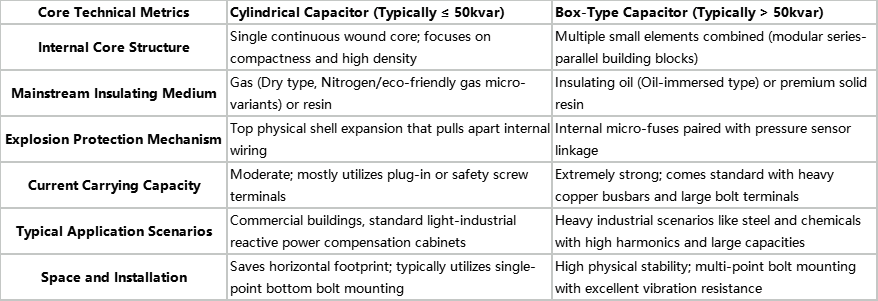
To assist in system design and project procurement, the core technical differences between the two variations are summarized below:
4. Practical Advice for Selection Engineers: How to Choose at the 50kvar Junction?
While 50kvar serves as the general industry watershed, breakthroughs in materials science and film technology have introduced 50kvar cylindrical capacitors to the market. However, this often represents the absolute physical limit of the cylindrical architecture. In actual engineering projects, how should you make the final choice?
- Evaluate Space and Budget: If the space inside the capacitor compensation cabinet is tight, and the project is a conventional commercial complex or a light industrial power grid free of harmonic pollution, choosing a 50kvar cylindrical capacitor can maximize space utilization while lowering procurement costs.
- Evaluate Grid Environment Harshness: If the project falls under heavy industrial manufacturing—where the system contains a high volume of non-linear loads such as variable frequency drives (VFDs) and intermediate frequency furnaces—and requires pairing with series reactors (such as 7% or 14% detuned reactors) for harmonic mitigation, it is highly recommended to prioritize box-type capacitors at and above the 50kvar threshold. The superior thermal stability and surge resistance of the box structure under dynamic reactive power compensation and harmonic overloads provide a far more robust safeguard for the enterprise's power grid.
Behind the physical form lies the intersection of physics, materials science, and electrical engineering. Only by understanding the secrets behind cylindrical and box designs can you navigate reactive power compensation layouts with ease, creating a high-quality PFC system that balances economic efficiency with ultimate stability.