

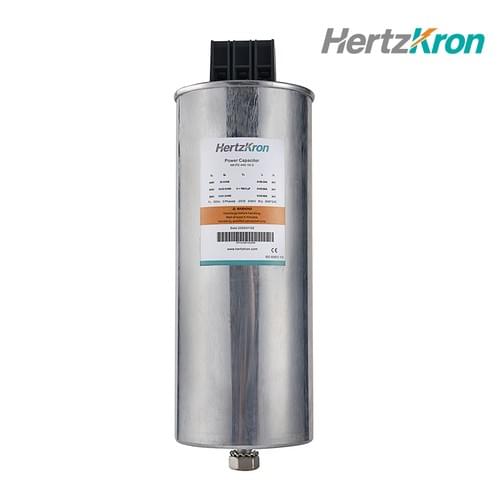
HK-PCL Series | Low Voltage MKP Power Capacitor (Heavy Duty)
$15-$150
Rated Capacity: 1~50kvar
Capacity deviation (μF): 0~+10%
Connection Type: Three-phase (Single-phase optional)
Rated Frequency: 50/60Hz
Ambient Temperature: -25℃~+55℃ (Class D)
AC withstands voltage: Inter-electrode: 2.15Un/10s; To shell: 3.6kV/10s
Allowable over-voltage (Un): 1.10 continuous, 1.15 (≤8h/24h), 1.20 (5 min), 1.30 (1 min)
Allowable over-current (In): 1.50In continuous (Max. transient 2.0In)
Max. Inrush Current (Is): 350In
Voltage to the ground (Ue): 3600V AC 50Hz
Altitude: ≤2000m (Up to 4000m optional)
Relative humidity: ≤50% at 40℃; ≤90% at 20℃
Appearance: Cylindrical Aluminum Case with Overpressure Disconnector
Inside Dipping Material: Metallized Polypropylene Film (Self-healing), Dry Type Solid Resin
Self-discharge characteristic: ≤50V within 60 seconds after power failure
Life Expectancy: ≥130,000 Hours
Standard: IEC/EN 60831-1/2, CE, EAC
Product Overview: HertzKron HK-PCL Series Heavy-Duty PFC Capacitor
Engineering Absolute Grid Resilience Through Physics-Based Parameter Logic.
The HertzKron HK-PCL Series (Heavy-Duty Type) is specifically engineered to thrive in high-stress industrial environments saturated with non-linear loads—such as Variable Frequency Drives (VFDs), heavy automation, and harmonic-heavy distribution networks. While standard capacitors degrade under electrical stress, the heavy-duty HK-PCL series utilizes enhanced voltage redundancy and optimized material physics to eliminate utility penalties and prevent network downtime without derating.
Engineering Logic & Core Advantages
⚡ 1. Rated Voltage Redundancy (Anti-Harmonic Design)
In heavy-duty applications, the operating voltage at the capacitor terminals is always higher than the nominal busbar voltage due to grid fluctuations and the voltage-boosting effect of series detuned reactors.
The Reactor Effect: In a 400V system equipped with a 7% detuned reactor, the voltage at the capacitor terminal automatically rises to approximately 430V.
The HertzKron Logic: We configure the heavy-duty HK-PCL units with a Rated Voltage of 450V, 480V, or 525V for 400V grids. This forward-looking configuration ensures that the electric field intensity remains strictly within the safe threshold of the dielectric medium, completely eliminating the root cause of premature capacitor swelling and breakdown.
📊 2. Capacity Synchronized Verification (The Square Law)
Rated Capacity (labeled in kvar) is a dynamic variable deeply coupled with operating voltage. The reactive power output of a capacitor is directly proportional to the square of the actual applied voltage.
The Capacity Shrinkage: If you run a capacitor with a Rated Voltage of 450V and a Rated Capacity of 25 kvar on a nominal 400V grid, its actual output capacity will shrink significantly to approximately 19.7 kvar.
The Solution: To avoid under-compensation and subsequent utility reactive penalties, HertzKron coordinates the verification of Rated Voltage against the Rated Capacity, ensuring the effective reactive support perfectly covers the load demand at actual operating levels.
🌡️ 3. Micro-Loss Technology & Thermal Management
Internal heat is the primary failure catalyst for power film. In the HK-PCL heavy-duty series, the Dielectric Loss—represented by the Tangent of the Loss Angle ($\tan\delta$)—is minimized to an industry-leading threshold.
The Micro-Watt Defense: The loss value is strictly engineered to be below 0.0002 (≤ 0.2W/kvar). By preventing the internal dielectric from converting electrical energy into destructive thermal energy under alternating electric fields, we stop the thermal aging of the polypropylene film and guarantee absolute structural stability.
Essential Technical Specifications
Brand: HertzKron
Series Model: HK-PCL Series (Heavy-Duty Type)
Design Architecture: Dry-Type, 99.999% Pure Nitrogen (N₂) Gas Filled
Dielectric Loss ($\tan\delta$): < 0.0002 at fundamental frequency
Temperature Category: -25/D (Engineered to sustain continuous ambient air up to 55°C and a 24-hour average of 45°C)
Safety Baseline: Advanced Self-Healing dielectric film with an integrated Overpressure Disconnector (ISD) mechanical "physical fuse" for zero-explosion risk.
Discharge Mechanism: Integrated high-reliability ceramic discharge resistors, automatically reducing residual voltage to below 50V within 3 minutes after disconnection.
Casing Material: High-grade cylindrical aluminum casing with optimized geometric aspect ratios for maximum radiant and convective heat dissipation.
International Compliance & Certifications
Engineered for global export and high-spec industrial bids, the heavy-duty HK-PCL series fully complies with the following international standards:
CE Marked: Compliant with Low Voltage Directive (LVD) and global safety mandates.
EAC Certified: Fully approved for Eurasian Customs Union and Middle Eastern project specifications.
Standard Compliance: IEC 60831-1/2, EN 60831-1/2.
Applications
Harmonic-Rich Industrial Plants (Automotive, Steel, Textile, and Paper Mills)
Detuned Automatic Power Factor Correction (APFC) Cabinets (Paired with 7% or 14% Reactors)
Main Distribution Boards (MDB) in Commercial Infrastructure and Data Centers
Decentralized Fixed Compensation for Large Electric Motors and Heavy Machinery

